 148 kcal
 P 12.4g C 0.96g F 9.96g
Unlike wheat flour, almond flour contains no gluten and relies entirely on eggs for structure in baked goods.
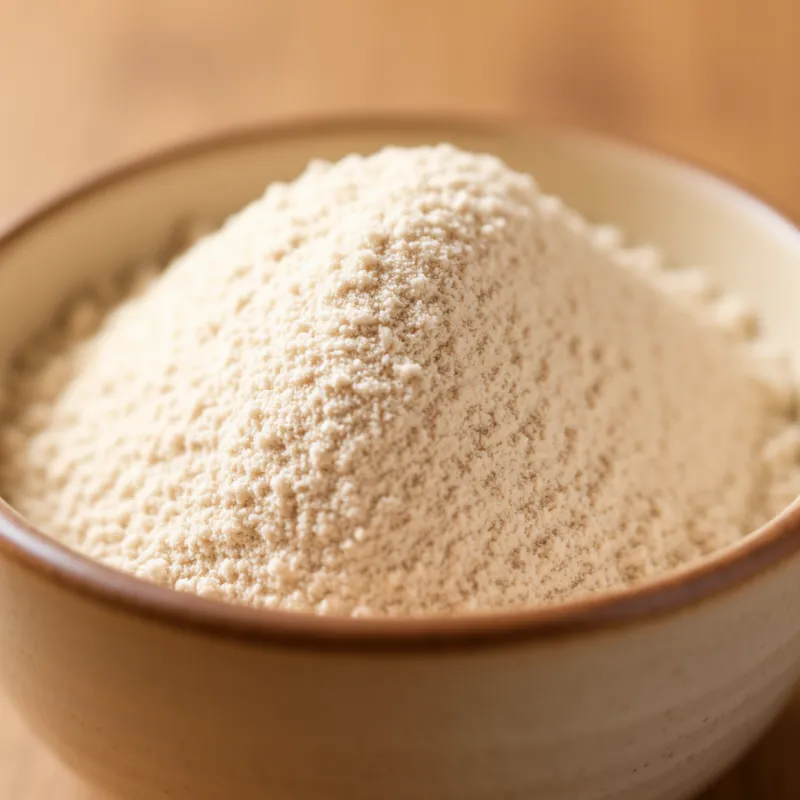
Almond flour is fundamentally just finely milled, blanched almonds, but its baking chemistry diverges sharply from cereal flours. Unlike wheat, almonds contain no starch and no gluten-forming proteins, meaning they cannot build the elastic network needed to trap carbon dioxide during fermentation or leavening. To prevent baked goods from crumbling into dense puddles, bakers must rely heavily on eggs or hydrocolloids like xanthan gum to provide structural scaffolding. Furthermore, almond flour's exceptionally high fat content—over 50% by weight, primarily heart-healthy monounsaturated oleic acid—coats the protein particles, interfering with aeration. This lipid matrix also alters heat transfer, causing almond flour baked goods to brown and scorch much faster than their wheat counterparts due to the rapid Maillard reaction between its abundant amino acids and trace sugars. Historically, almond paste and ground almonds were staples in medieval European and Middle Eastern kitchens long before the modern concept of flour existed, prized precisely because they didn't require milling infrastructure and could be ground on demand. Today, its resurgence is driven by ketogenic and paleo diets, leveraging its high fat-to-carbohydrate ratio.
Store almond flour in an airtight container in the refrigerator or freezer to prevent its high fat content from oxidizing and turning rancid. When substituting for wheat flour in baking, use a 1:1 ratio by weight rather than volume, and add an extra egg or binder to prevent crumbling. Reduce the oven temperature by 25°F and monitor closely to avoid over-browning. It pairs exceptionally well with citrus zest and spices like cardamom, which complement its rich, nutty profile.
Per 100g — daily values based on a 2,000 calorie diet
CalRay's AI recognizes flour and hundreds of thousands of other foods from a photo. No manual lookup needed.
Flour, almond contains 621 calories per 100g. A standard serving of 1 RACC (15g) provides 93 calories. It is relatively calorie-dense, so portion control is important.
Flour, almond provides 26.2g of protein per 100g, which is 52% of the 50g daily recommended value. It is an excellent source of protein.
Flour, almond contains 16.2g of carbohydrates per 100g . It also provides 9.27g of dietary fiber.
Flour, almond has 621 kcal per 100g, so portions need to be monitored on a weight-loss diet. Use CalRay to track your intake accurately. Its high protein content (26.2g/100g) helps with satiety. Its fiber content (9.27g/100g) also promotes fullness.
The easiest way to track flour is with CalRay. Simply snap a photo of your meal and the AI will automatically identify the food and calculate calories and macros based on the estimated portion size — no manual lookup required. You can also search by name and adjust gram weight manually.
148 kcal  833 kcal
  36 kcal