 314 kcal
 P 11.7g C 2.89g F 28g
American cheese is an engineered marvel of dairy emulsion rather than a traditional aged cheese.
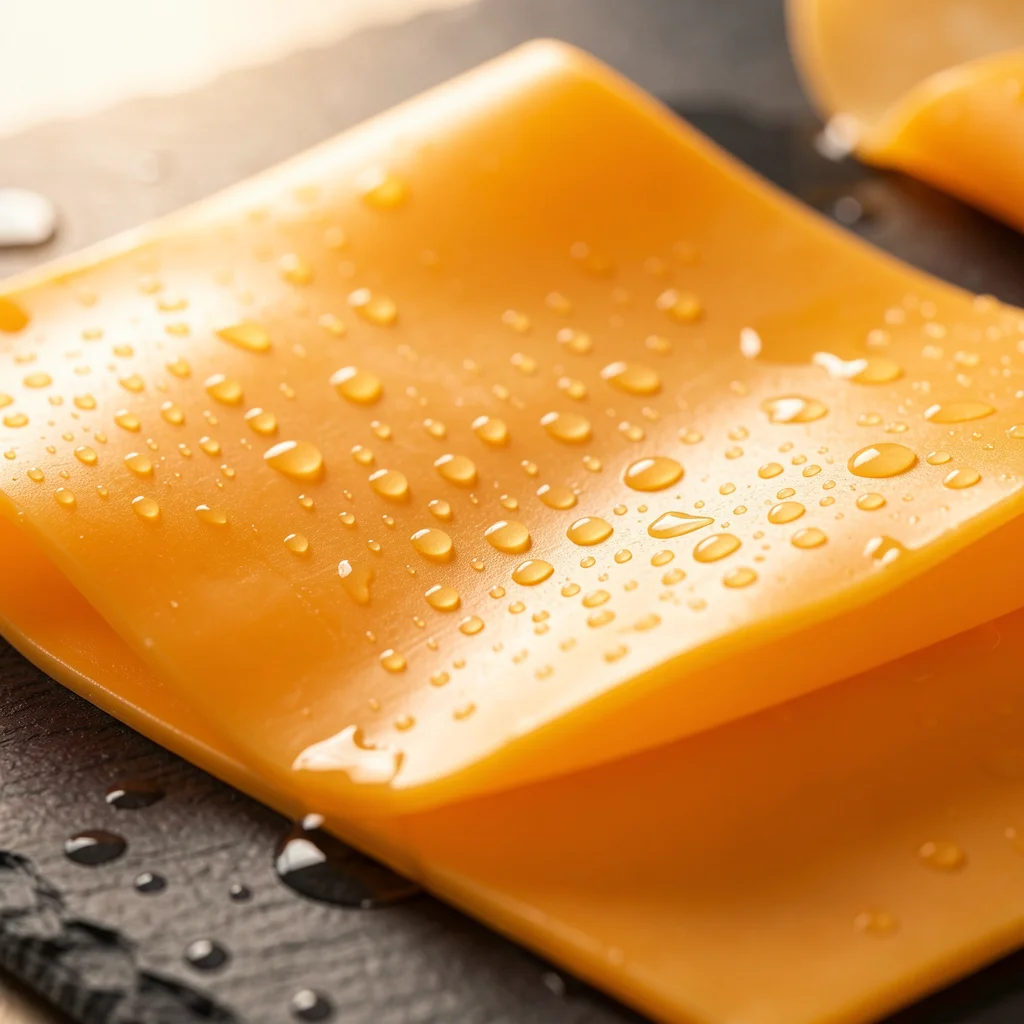
American cheese was born from a practical problem: how to salvage cheese wheels that cracked or aged unevenly. In 1916, James L. Kraft patented a method of heating cheddar and blending it with sodium citrate, a salt that fundamentally alters the dairy protein matrix. Sodium citrate acts as an emulsifying salt, peeling calcium away from the casein proteins. This allows the proteins to unfold and interact with water and fat, creating a stable, smooth emulsion that resists separating when heated. Because of these added emulsifiers and moisture, the FDA legally classifies most American cheese as a pasteurized process cheese product rather than natural cheese. This chemical engineering is exactly why restaurant American cheese melts flawlessly into a gooey, uniform layer on a burger without leaking oil, a feat natural cheddar cannot replicate under high heat. The trade-off for this perfect melt is a higher sodium content and a milder, standardized flavor profile designed for mass appeal and consistent cooking performance.
Use restaurant-style American cheese specifically when you need a smooth, cohesive melt without fat separation, such as in cheese sauces, grilled cheese sandwiches, or on burgers. Because it is high in sodium and saturated fat (31.1g per 100g), balance it with low-sodium, high-fiber ingredients. Store it tightly wrapped in the refrigerator to prevent moisture loss and oxidation, which can cause the emulsion to break and turn gritty during cooking.
Per 100g — daily values based on a 2,000 calorie diet
CalRay's AI recognizes cheese and hundreds of thousands of other foods from a photo. No manual lookup needed.
Cheese, American, restaurant contains 375 calories per 100g. It is relatively calorie-dense, so portion control is important.
Cheese, American, restaurant provides 17.5g of protein per 100g, which is 35% of the 50g daily recommended value. It is a good source of protein.
Cheese, American, restaurant contains 6.35g of carbohydrates per 100g .
Cheese, American, restaurant has 375 kcal per 100g, so portions need to be monitored on a weight-loss diet. Use CalRay to track your intake accurately. Its high protein content (17.5g/100g) helps with satiety.
The easiest way to track cheese is with CalRay. Simply snap a photo of your meal and the AI will automatically identify the food and calculate calories and macros based on the estimated portion size — no manual lookup required. You can also search by name and adjust gram weight manually.
314 kcal  12 kcal
  27 kcal