 884 kcal
 P 0g C 0g F 100g
Beet greens often outshine the root they grow above, packing more iron and calcium per calorie than the beet itself.
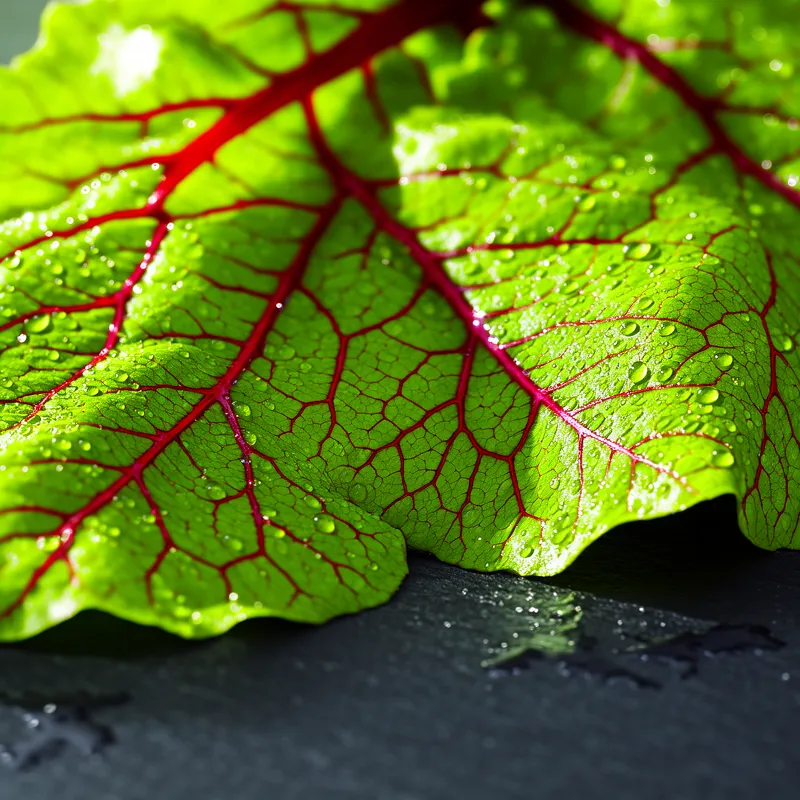
Beet greens are botanically the same species as Swiss chard (Beta vulgaris), sharing a common ancestor in the sea beet, a coastal plant native to the Mediterranean. While modern beets were selectively bred to enlarge their taproot, the greens were historically the primary edible portion of the plant for centuries. Ancient Romans and Greeks primarily consumed the leaves, using the roots mostly for medicinal purposes before larger-rooted cultivars emerged in the 16th century. Chemically, the vibrant stems and leaf veins contain betalain pigments—betacyanins and betaxanthins—which act as powerful antioxidants. These nitrogen-containing pigments are distinct from the anthocyanins found in most other red and purple vegetables. Unlike anthocyanins, betalains maintain their structural integrity and color stability across a wider pH range, which is why pickled beets retain such a vivid hue. The leaves themselves are rich in lutein and zeaxanthin, carotenoids that selectively accumulate in the human retina to filter damaging blue light. Because beet greens contain high levels of oxalates, naturally occurring organic acids, they can bind to calcium and reduce its absorption in the digestive tract.
To maximize nutrient absorption and reduce oxalate content, beet greens are best cooked rather than eaten raw. Sautéing them with a splash of olive oil or boiling them briefly and discarding the water helps leach out oxalates. Pair them with a calcium-rich food like feta cheese to balance the oxalate effect, or squeeze lemon juice over them to enhance iron absorption from their high non-heme iron content. Store them unwashed in a plastic bag in the refrigerator for up to three days.
Per 100g — daily values based on a 2,000 calorie diet
CalRay's AI recognizes beet greens and hundreds of thousands of other foods from a photo. No manual lookup needed.
Beet greens contains 26 calories per 100g. It is considered a very low-calorie food (under 50 kcal/100g), making it excellent for weight management.
Beet greens provides 1.61g of protein per 100g, which is 3% of the 50g daily recommended value. It is not a primary protein source.
Beet greens contains 4.66g of carbohydrates per 100g . It also provides 2.58g of dietary fiber.
Yes! Beet greens is very low in calories (26 kcal/100g) and can be eaten in generous portions even on a calorie-restricted diet.
The easiest way to track beet greens is with CalRay. Simply snap a photo of your meal and the AI will automatically identify the food and calculate calories and macros based on the estimated portion size — no manual lookup required. You can also search by name and adjust gram weight manually.
884 kcal  273 kcal
  143 kcal