 884 kcal
 P 0g C 0g F 100g
Cooking tomatoes into puree unlocks their heart-protecting lycopene in a way raw tomatoes never could.
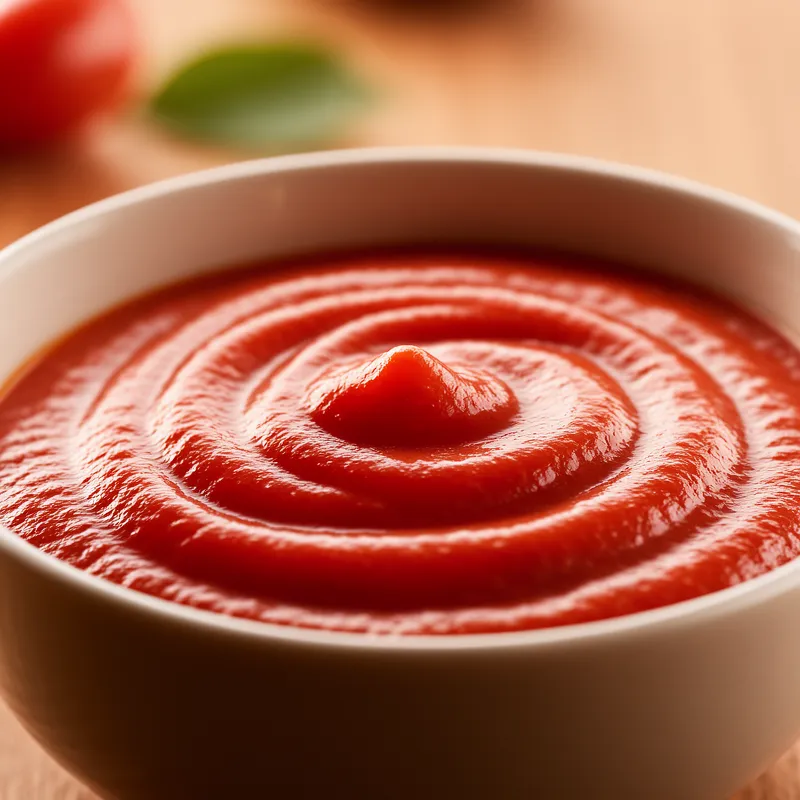
Tomato puree is made by cooking tomatoes briefly to break them down, then straining out the skins and seeds to yield a thick, smooth liquid. Unlike raw tomatoes, which contain high levels of water, puree concentrates the fruit's solids, including its most valuable phytonutrient: lycopene. Lycopene is the carotenoid pigment responsible for the tomato's red hue, and it is a potent antioxidant linked to cardiovascular and cellular health. In raw tomatoes, lycopene exists predominantly in a crystalline trans-isomer form, tightly bound within the plant's cell walls, making it difficult for the human digestive tract to absorb. The thermal processing required to create tomato puree disrupts these cellular structures and induces a geometric isomerization, converting some of the trans-lycopene into the cis-isomer form. This cis-configuration is far more soluble in lipids and significantly more bioavailable to humans. Consequently, a serving of tomato puree delivers antioxidants that the body can actually utilize much more effectively than an equivalent amount of fresh, raw fruit.
Because lycopene is fat-soluble, your body absorbs it far more efficiently when tomato puree is paired with a source of dietary fat. Sauté the puree in extra virgin olive oil or butter before building a sauce, soup, or stew. Store unopened cans in a cool, dark pantry, but transfer any leftover puree to a non-metallic, airtight container and refrigerate for up to five days. For longer storage, freeze portioned puree in ice cube trays to easily drop into future recipes.
Per 100g — daily values based on a 2,000 calorie diet
CalRay's AI recognizes tomato and hundreds of thousands of other foods from a photo. No manual lookup needed.
Tomato, puree contains 41 calories per 100g. A standard serving of 1 RACC (130g) provides 53 calories. It is considered a very low-calorie food (under 50 kcal/100g), making it excellent for weight management.
Tomato, puree provides 1.58g of protein per 100g, which is 3% of the 50g daily recommended value. It is not a primary protein source.
Tomato, puree contains 8.04g of carbohydrates per 100g . It also provides 1.97g of dietary fiber.
Yes! Tomato, puree is very low in calories (41 kcal/100g) and can be eaten in generous portions even on a calorie-restricted diet.
The easiest way to track tomato is with CalRay. Simply snap a photo of your meal and the AI will automatically identify the food and calculate calories and macros based on the estimated portion size — no manual lookup required. You can also search by name and adjust gram weight manually.
884 kcal  143 kcal
  38 kcal