 884 kcal
 P 0g C 0g F 100g
Shallots grow in clustered cloves like garlic but are botanically a variety of onion, not a separate species.
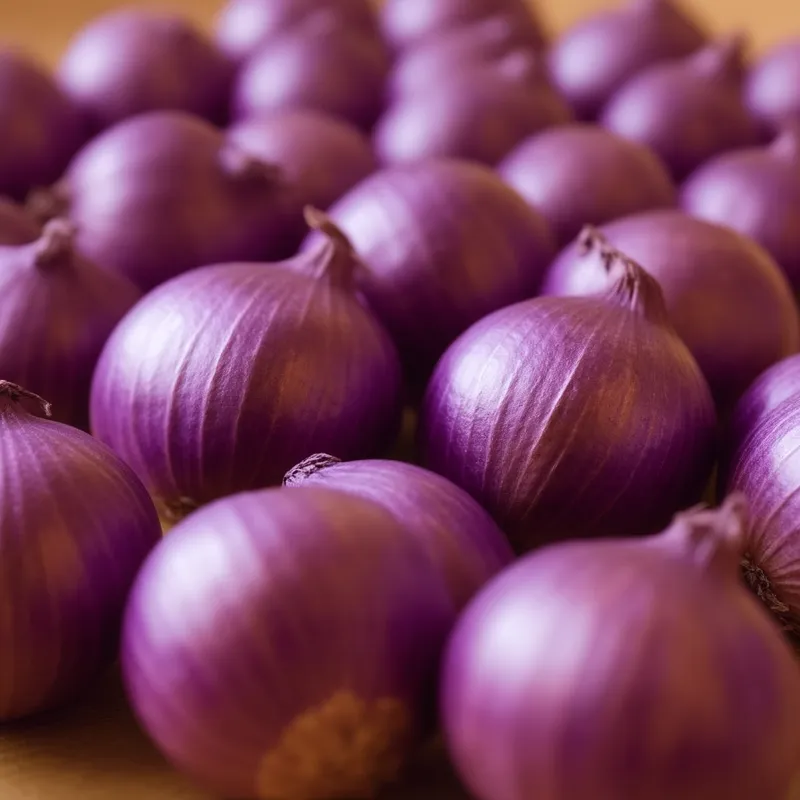
The word 'shallot' derives from Ashkelon, an ancient trading city in present-day Israel, from which Crusaders reportedly carried the bulbs to medieval Europe. Botanically, shallots are classified as Allium cepa var. aggregatum — a subspecies of the common onion that, unlike standard onions, multiplies underground into a cluster of separate cloves rather than forming a single bulb. Most traditional shallot cultivars are propagated vegetatively from bulbs rather than from seed, because many varieties produce flowers but set viable seed poorly or not at all. This reproductive quirk means that shallot genetics are preserved clonally across generations, which is why heirloom shallot lines can remain remarkably consistent for centuries. Chemically, shallots differ from common onions in their balance of organosulfur precursors: they contain proportionally more of certain S-alk(en)yl-L-cysteine sulfoxides that, when the tissue is cut and the enzyme alliinase is released, yield a sweeter, more complex volatile profile than the sharper, more acrid compounds dominant in yellow or white onions. This is why shallots taste gentler and more layered even though they belong to the same species.
Mince shallots finely and sweat them gently in olive oil over low heat before building a vinaigrette, pan sauce, or braise — their lower water content means they caramelize faster than yellow onions and burn more easily, so keep the heat moderate. For raw applications like dressings or salsas, soak minced shallot in a splash of vinegar for ten minutes to mellow their bite. Store whole, unpeeled shallots in a cool, dry, dark spot with good airflow; once peeled, refrigerate and use within several days.
Per 100g — daily values based on a 2,000 calorie diet
CalRay's AI recognizes shallots and hundreds of thousands of other foods from a photo. No manual lookup needed.
Shallots, bulb, peeled, root removed contains 6 calories per 100g. A standard serving of 1 RACC (85g) provides 5 calories. It is considered a very low-calorie food (under 50 kcal/100g), making it excellent for weight management.
Shallots, bulb, peeled, root removed provides 1.38g of protein per 100g, which is 3% of the 50g daily recommended value. It is not a primary protein source.
Shallots, bulb, peeled, root removed contains 0g of carbohydrates per 100g . It also provides 2.2g of dietary fiber.
Yes! Shallots, bulb, peeled, root removed is very low in calories (6 kcal/100g) and can be eaten in generous portions even on a calorie-restricted diet.
The easiest way to track shallots is with CalRay. Simply snap a photo of your meal and the AI will automatically identify the food and calculate calories and macros based on the estimated portion size — no manual lookup required. You can also search by name and adjust gram weight manually.
884 kcal  143 kcal
  22 kcal